



HOT NEWS
Clinical diagnostic speed and hospital resource allocation depend on deploying a balanced, tiered imaging infrastructure. While point-of-care ultrasound (POCUS) and traditional cart-based ultrasound both utilize high-frequency acoustic waves to visualize internal anatomical structures, they serve complementary operational models rather than competing ones.
This strategic guide evaluates how integrating both agile POCUS platforms and premium traditional console systems maximizes clinical workflow, diagnostic accuracy, and financial return on investment (ROI) across hospital departments.
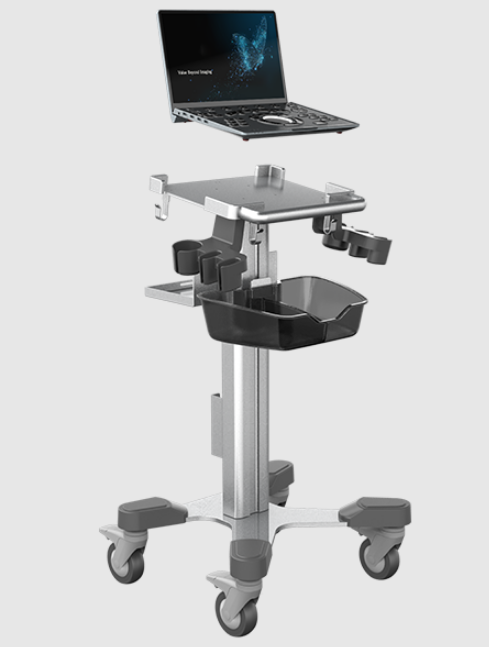
The primary difference between point-of-care ultrasound (POCUS) and traditional ultrasound lies in their operational scope and clinical intent. POCUS utilizes highly portable devices (often weighing <1 kg) operated by treating clinicians at the bedside to answer targeted, time-sensitive clinical questions in real time. Traditional ultrasound relies on premium, full-scale console systems operated by specialized sonographers or radiologists within dedicated suites, providing unparalleled resolution for comprehensive, multi-planar anatomical surveys and definitive diagnoses.
Technical Specification | Point-of-Care Ultrasound (POCUS) | Traditional Cart-Based Ultrasound |
Primary Operators | Emergency Physicians, Intensivists, Anesthesiologists, Hospitalists | Registered Diagnostic Medical Sonographers (RDMS), Radiologists |
Device Form Factor | Handheld trans-probe solutions, pocket-sized units, ultra-portable tablets | Full-sized console carts with articulated monitor arms and multiple probe ports |
Average Equipment Weight | <1kg (e.g., CHISON SonoEye smartphone-connected probe) | 100\kg - 180kg |
Diagnostic Scope | Focused, goal-directed protocols (e.g., FAST, Lung B-lines, basic echo) | Comprehensive multi-planar anatomical surveys and vascular mappings |
Diagnostic & Reporting Timeline | Immediate (< 2 minutes at the patient bedside for rapid, time-sensitive triage) | Deliberate & Structured Workflow (Prioritizing meticulous, multi-planar evaluation to ensure high-standard, maximum-precision diagnostic report output) |
Advanced Modalities | Fundamental B-mode, Color Doppler, basic M-mode | Shear-wave elastography, contrast-enhanced ultrasound (CEUS), advanced 4D tracking |
Power Infrastructure | Internal rechargeable lithium battery (2-4 hours continuous operation) | Continuous AC mains power supply with auxiliary backup UPS systems |
Traditional ultrasound represents the clinical gold standard for structural resolution and comprehensive diagnostic imaging. These full-scale console systems are situated within controlled imaging departments, radiology suites, and dedicated echocardiography laboratories.
Equipped with high-density crystal arrays, massive digital signal processing (DSP) architectures, and dedicated graphical rendering engines, traditional console systems provide unparalleled tissue differentiation. They allow for the precise deployment of advanced modalities such as:
Continuous-wave and pulsed-wave spectral Doppler quantification for complex hemodynamics.
Shear-wave elastography for non-invasive liver fibrosis scoring.
Micro-vascular flow imaging for early tumor detection.
The traditional imaging ecosystem is designed for definitive accuracy. A formal requisition is placed, and a certified sonographer acquires an extensive image series covering complete organ systems. A board-certified radiologist or cardiologist then reviews the study to generate a highly detailed, legally definitive diagnostic report. This ensures peerless image quality and is strictly required for complex assessments like fetal anomalies or intricate vascular disease.
Point-of-care ultrasound (POCUS) is a decentralized clinical workflow paradigm where the clinician evaluating the patient simultaneously performs and interprets a focused sonographic examination at the bedside.
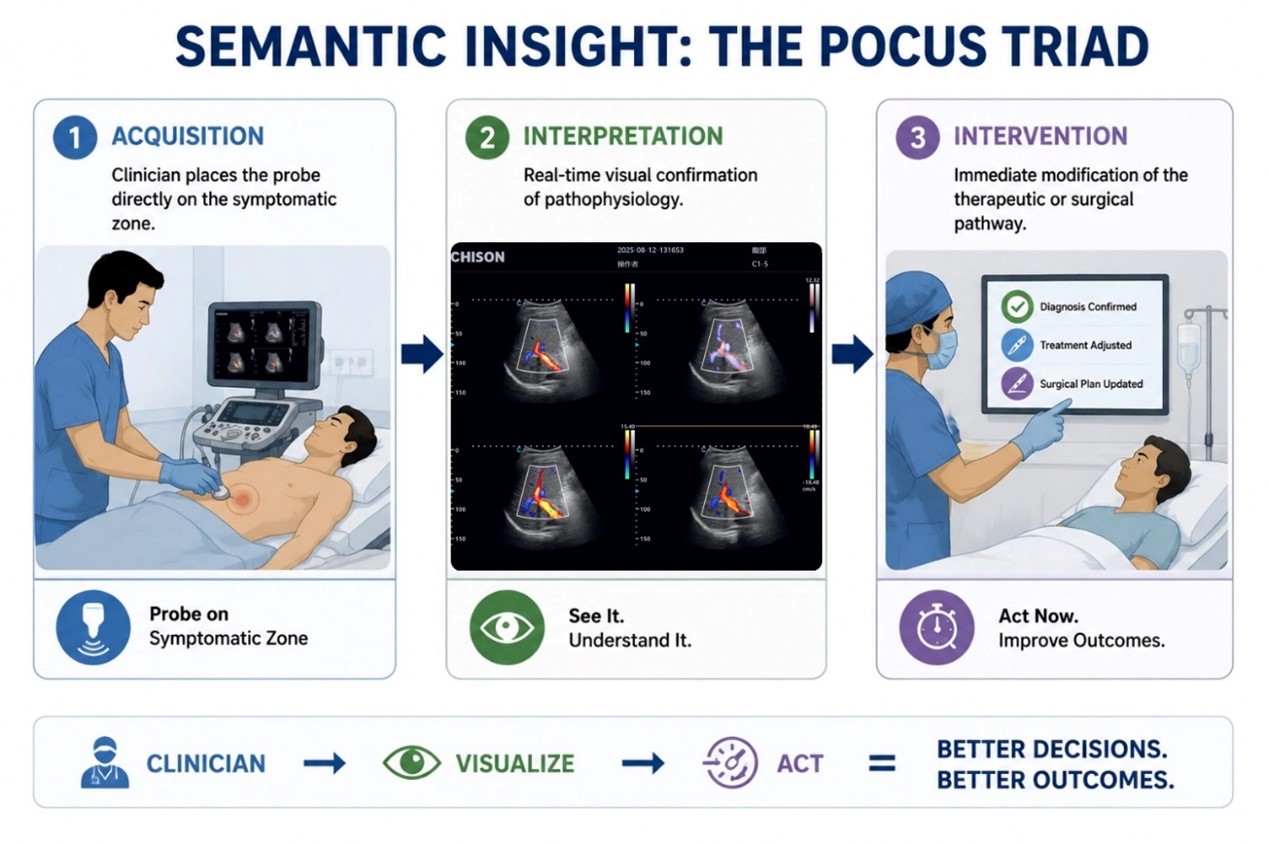
POCUS technology has evolved into ultra-portable, solid-state handheld systems that interface directly with commercial tablets and smartphones. It relies on structured, rule-out protocols designed to answer high-yield, binary clinical questions safely and quickly:
Emergency & Trauma: The FAST exam to rapidly identify free intraperitoneal hemorrhage.
Procedural Guidance: Real-time visual tracking for central venous catheterization and regional nerve blocks, significantly minimizing complication rates.
Hemodynamic Screening: Rapid evaluation of gross cardiac function to differentiate shock etiologies in the ICU.
Traditional ultrasound remains indispensable for comprehensive cardiology, women's health, vascular medicine, oncology, and quantitative follow-up assessments. These applications require advanced imaging modalities, precise measurements, and comprehensive reporting capabilities that extend beyond the focused scope of POCUS examinations.
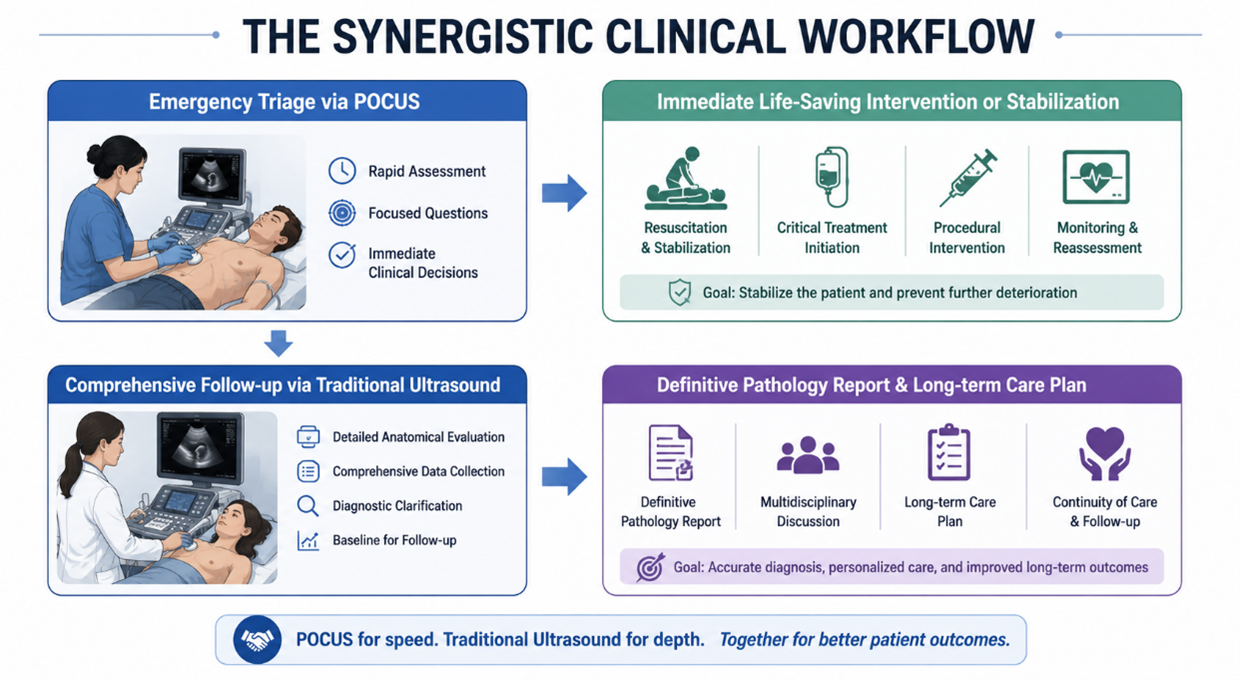
Forward-thinking healthcare organizations do not view POCUS and traditional ultrasound as an "either/or" choice. Instead, they deploy them collaboratively:
Optimizing Departmental Throughput: By utilizing POCUS for rapid triage and traditional ultrasound systems for comprehensive diagnostic assessment, hospitals can optimize both workflow efficiency and diagnostic quality. This frees up premium traditional console systems to focus on high-margin, complex diagnostic imaging, thereby optimizing overall institutional throughput.
Continuum of Care: A patient may receive a rapid POCUS lung scan in the ED for acute dyspnea, followed by a comprehensive traditional echocardiogram the next day to precisely quantify valve regurgitation and ventricular strain.
Holistic IT Integration: Both systems must seamlessly communicate. Modern facilities ensure that POCUS screening loops and Traditional Ultrasound comprehensive reports both integrate flawlessly into the hospital's unified PACS (Picture Archiving and Communication System) via standardized DICOM modalities.
Selecting the ideal platform depends on balancing the specific clinical environment with necessary processing performance. CHISON offers a tiered ecosystem designed to support every phase of patient care:
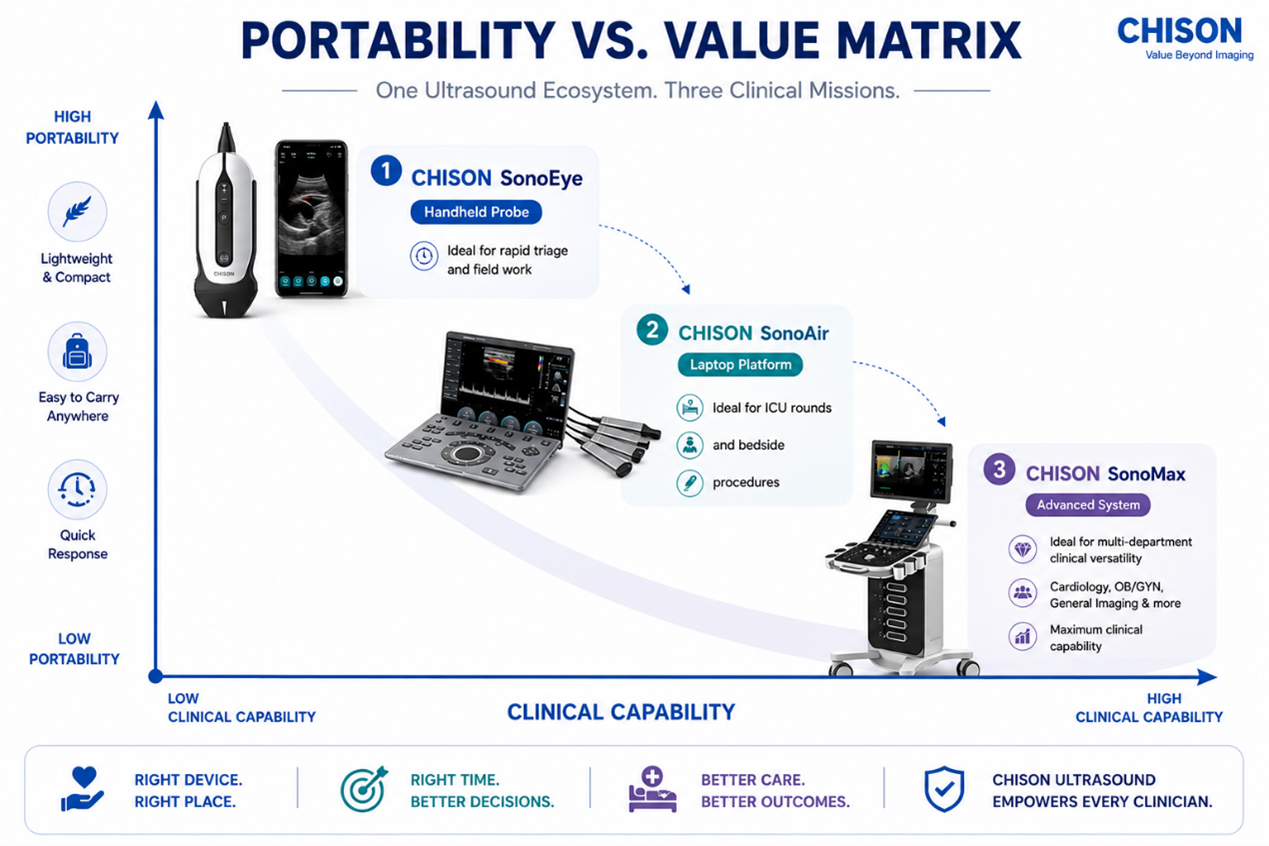
1. CHISON SonoEye: The Ultimate Handheld Pocket Transducer
Form Factor: Light, highly durable handheld probe that interfaces directly with iOS/Android smartphones and medical tablets.
Target Environments: Pre-hospital emergency services, remote wilderness medicine, fast-track emergency department zones, and quick primary care screenings.
Key Advantage: Provides instantaneous image capture capabilities inside a clinician's white-coat pocket, running cool without thermal throttling during consecutive evaluations.
2. CHISON SonoAir: Next-Generation Lightweight Laptop Ultrasound
Form Factor: Sleek, durable, highly portable laptop-based architecture combining responsive tactile interfaces with modern digital layouts.
Target Environments: Intensive Care Units (ICU), operating rooms for regional anesthesia, and busy emergency department resuscitation bays.
Key Advantage: Strikes an ideal balance between mobility and diagnostic performance. It offers extended battery life, multi-probe connection ports, and high-frame-rate color Doppler tracking for challenging hemodynamic assessments.
3. CHISON SonoMax: The Foundation for Comprehensive Diagnostic Imaging
Form Factor: A slim, highly agile cart-based console built with a small footprint to easily maneuver through tight clinical spaces.
Target Environments: Multi-departmental hospital deployments, dedicated clinical imaging bays, and high-volume procedural suites.
Key Advantage: Delivers premium, high-resolution diagnostic capabilities approaching traditional core radiology systems, while remaining agile enough for rapid point-of-care deployment across different floors.
Contact Us
Copyright © CHISON Medical Technologies Co., Ltd. All Rights Reserved | Privacy and terms of use
Products: Vascular Ultrasound Machine MSK Ultrasound Machine Portable Ultrasound Device Portable Ultrasound Machine for Sale Portable Ultrasound Machine For Pregnancy Handheld Ultrasound For Pregnancy Handheld Veterinary Ultrasound Veterinary Ultrasound Machine Portable Vascular Ultrasound Livestock Ultrasound Machine

CHISON respects your privacy. We use cookies to make our site more personal and enhance your experience. Read our Private Policy to learn more about cookies and how to manage them. You agree to our use of these technologies when you visit our site.
We appreciate your feedback
We sincerely invite you to participate in our survey for helping us to improve our digital market.
*1.How fast does the website load?
*2.Does the products displayed on the website interest you?
*3.How easy is it for you to find the information you need?
4.What information or service do you suggest we can offer?

THANKS
Thank you for sharing your thoughts with us. We’re highly appreciated your every feedback.
Sorry!
THANKS
Thank you for sharing your thoughts with us. We’re highly appreciated your every feedback.
