



HOT NEWS
Choosing the right ultrasound probes is essential when purchasing a portable ultrasound system. For hospitals, clinics, and medical equipment distributors, an unsuitable probe configuration can limit clinical applications, increase purchasing costs, and create unnecessary workflow interruptions.
CHISON offers a range of portable ultrasound systems, including SonoAir and SonoBook models, with different transducer options and connector configurations. Buyers should select probes according to examination requirements, compatibility, and daily usage rather than ordering the largest available probe package.
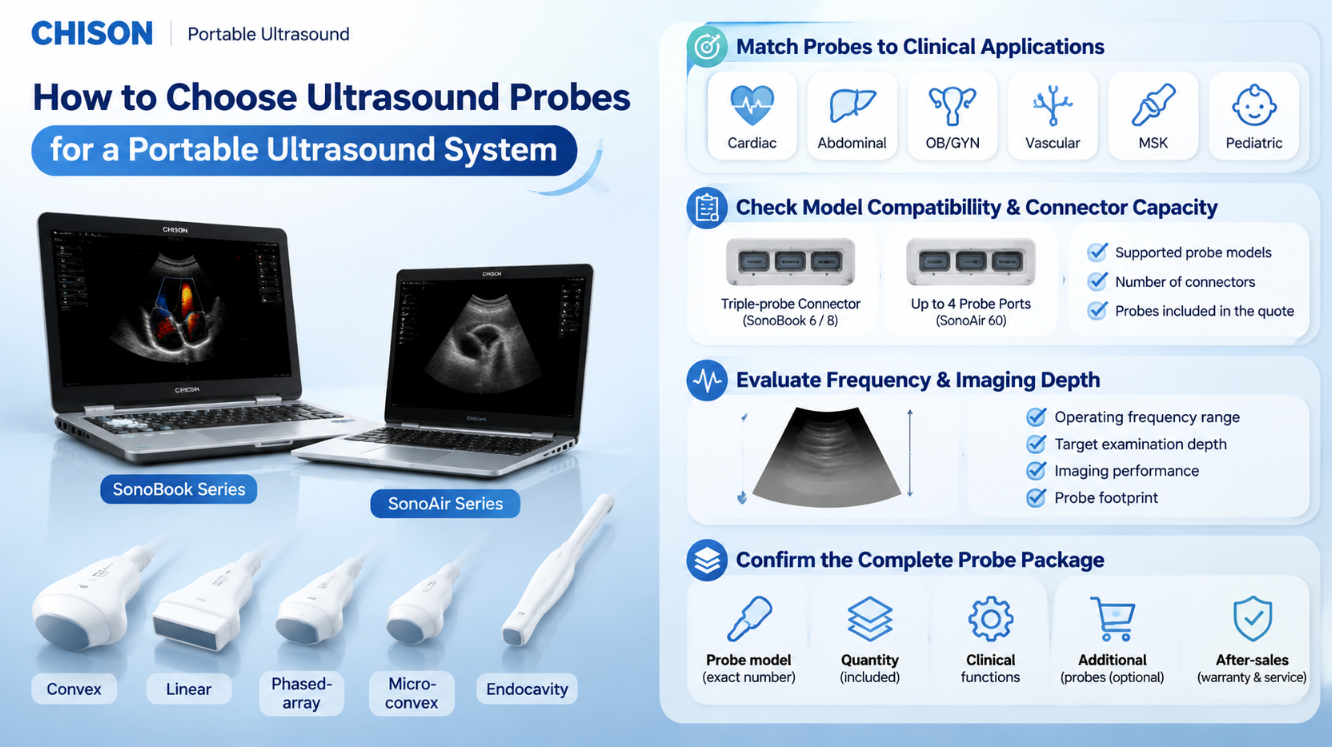
Different ultrasound probes are designed for different imaging depths, anatomical structures, and examination requirements.
Probe type | Typical applications | Key purchasing considerations |
Convex probe | Abdominal, obstetric, and general imaging | Imaging depth, field of view, supported frequency range |
Linear probe | Vascular, thyroid, breast, musculoskeletal, and superficial structures | High-frequency imaging, superficial resolution, probe footprint |
Phased-array probe | Cardiac and selected critical care examinations | Cardiac imaging capability, Doppler modes, measurement tools |
Micro-convex probe | Pediatric and examinations requiring a smaller contact surface | Probe footprint, imaging depth, intended applications |
Endocavity probe | Gynecological and other approved internal examinations | Probe compatibility, applicable presets, cleaning requirements |
For example, a general practice clinic performing mainly abdominal examinations may prioritize a convex probe. A department providing vascular access guidance may also require a linear probe.
Before ordering, identify which examinations account for most of the department's daily workload. This helps avoid purchasing additional transducers that will rarely be used.
Not every ultrasound probe is compatible with every portable ultrasound machine. Buyers should check the exact transducer models supported by their selected system.
CHISON provides model-specific transducer information. For example:
CHISON model | Published compatible transducer examples | Probe connection information |
C3-V, L7-V, L12-V, MC3-V, MC6-V, P2-V, R7-V | Triple-probe connector | |
C3-V, L7-V, L12-V, MC3-V, P2-V, P5-V and additional listed models | Triple-probe connector configuration | |
Refer to its model-specific transducer information | Maximum four probe ports |
These are examples from CHISON's published product information, not complete compatibility lists.
When comparing ultrasound probes, buyers should request the exact probe model numbers, confirm compatibility with the proposed system, and verify whether the required transducers are included in the quotation.
This is especially important for distributors purchasing multiple systems, where probe selection mistakes can create delivery, replacement, and after-sales problems.

Probe frequency affects imaging resolution and penetration depth. Higher-frequency probes generally provide better resolution for superficial structures, while lower-frequency probes are commonly selected for deeper examinations.
However, the appropriate frequency depends on patient characteristics, examination depth, and the specific transducer.
For example, CHISON's SonoBook 8 product information identifies a transducer offering covering a broad frequency range of 1.5–23 MHz. This does not mean every individual probe operates across that entire range.
Buyers should verify:
Operating frequency range: Confirm the published range for the specific transducer model.
Target examination depth: Check whether the selected probe is suitable for the anatomical structures being examined.
Imaging performance: Evaluate representative images and, where possible, request a clinical demonstration.
Probe footprint: Consider whether the contact surface is appropriate for the intended examination.
Avoid selecting ultrasound probes based only on their maximum frequency. A higher frequency does not automatically make a probe more suitable for every clinical application.
Portable ultrasound systems may support multiple applications, but switching between transducers can affect examination efficiency.
For example, the CHISON SonoBook 6 features a triple-probe connector, while the SonoAir 60 supports a maximum of four probe ports.
For a multi-specialty clinic using convex, linear, and phased-array probes throughout the day, connector capacity can influence how frequently staff need to disconnect and reconnect transducers.
Before choosing a configuration, consider:
How many different probe types are used during a typical working day?
Do multiple departments share the same portable ultrasound system?
Can the required probes remain connected simultaneously?
Are additional connectors or accessories included in the proposed configuration?
A suitable connection arrangement can simplify routine workflow without requiring unnecessary equipment.
A portable ultrasound quotation should clearly identify both the main system and its accompanying transducers.
Quotation item | What buyers should verify |
Probe model | Exact CHISON transducer model number |
Probe quantity | Number of transducers included |
Compatibility | Supported ultrasound system and configuration |
Clinical functions | Required presets, imaging modes, and measurements |
Additional probes | Availability and separate purchasing cost |
After-sales service | Probe warranty, repair, and replacement arrangements |
For hospitals and distributors, probe replacement and service support also deserve attention. These details can influence long-term equipment costs, particularly when systems are used frequently across different departments.
Selecting ultrasound probes requires more than matching a transducer type to a clinical application. Compatibility, frequency range, connector capacity, and included accessories should all be confirmed before purchasing.
CHISON offers different probe configurations across its SonoBook and SonoAir portable ultrasound series.
Contact CHISON with your intended examinations, preferred ultrasound model, required probe types, and purchasing quantity. Our team can help you confirm compatible transducers and request a quotation for the appropriate portable ultrasound configuration.
Contact Us
Copyright © CHISON Medical Technologies Co., Ltd. All Rights Reserved | Privacy and terms of use
Products: Vascular Ultrasound Machine MSK Ultrasound Machine Portable Ultrasound Device Portable Ultrasound Machine for Sale Portable Ultrasound Machines For Pregnancy Handheld Ultrasound For Pregnancy Handheld Veterinary Ultrasound Veterinary Ultrasound Machine Portable Vascular Ultrasound Livestock Ultrasound Machine

CHISON respects your privacy. We use cookies to make our site more personal and enhance your experience. Read our Private Policy to learn more about cookies and how to manage them. You agree to our use of these technologies when you visit our site.
We appreciate your feedback
We sincerely invite you to participate in our survey for helping us to improve our digital market.
*1.How fast does the website load?
*2.Does the products displayed on the website interest you?
*3.How easy is it for you to find the information you need?
4.What information or service do you suggest we can offer?

THANKS
Thank you for sharing your thoughts with us. We’re highly appreciated your every feedback.
Sorry!
THANKS
Thank you for sharing your thoughts with us. We’re highly appreciated your every feedback.
