



Blog
Clinical tradeoffs and when to choose each
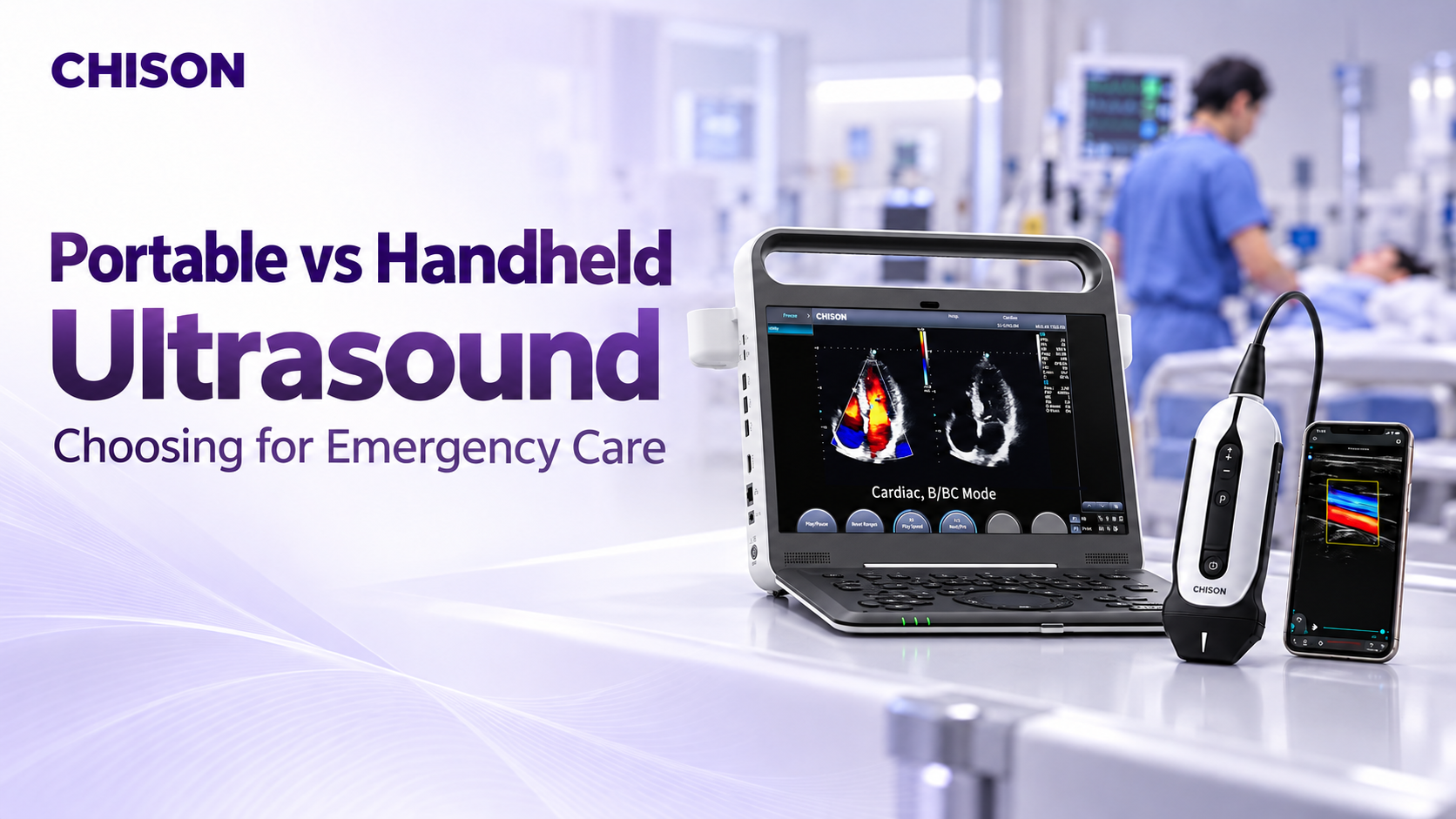
Handheld ultrasound can suit emergency teams that need a compact device close to the patient for focused assessments. A portable system with an integrated display can suit an emergency department that needs multiple probes, shared viewing and a broader examination workflow. Neither format is universally better: choose the specific device around the clinical task, trained operator and documentation pathway.
CHISON offers both approaches through SonoEye handheld devices and SonoAir and SonoGO portable systems. This guide explains how to evaluate their roles in an emergency service, rather than rank brands by unsupported claims about speed or diagnostic accuracy.
For the general differences in equipment format, see our portable versus handheld ultrasound guide. Here, the focus is emergency department and mobile-care workflow.
The useful question is not simply which device is smaller. It is which complete setup lets the team obtain, interpret and document the required examination without disrupting care.
Decision factor | Handheld setup | Portable system |
Getting ready | Check host-device access, app readiness and probe connection | Check storage location, start-up and positioning |
Clinical capability | Verify the exact scanner, modes and supported tasks | Verify each probe, software option and measurement package |
Viewing | Assess the actual phone or tablet and its mounting | Assess integrated display visibility for operator and team |
Power | Include the host device and any scanner power requirements | Test runtime, standby and charging in the intended use |
Records | Test patient matching, export and review | Test the complete archive and reporting connection |
These are evaluation criteria, not proof that every handheld is faster or every portable system has better imaging. Compare the shortlisted configurations using the same task and representative users.
For a department performing protocol-based trauma ultrasound, assess access to the required views, probe switching, team visibility and clip storage. A portable system may fit a shared bay where several users and transducers are involved. A handheld may fit a focused assessment where a compatible scanner is immediately available. The device must support the intended examination and the operator’s credentialed scope.
A handheld with the appropriate transducer can be a practical candidate for focused bedside questions. A portable system may be preferable when the planned assessment requires additional probes, measurements or a display that several team members can view. Choose by demonstrated capability rather than assuming all devices in one category have the same limits.
In cardiac arrest, ultrasound selection is secondary to maintaining the resuscitation workflow. The device should be familiar to the operator and positioned without obstructing the team.
The Resuscitation Council UK 2025 adult advanced life support guidelines state that intra-arrest POCUS should be used only by skilled operators and must not create extra or prolonged pauses in chest compressions. Ultrasound assessment of myocardial contractility must not be the sole reason for stopping CPR.
A compact handheld kit may be easier to carry into confined spaces, but size alone does not establish suitability for use in a vehicle. Evaluate secure mounting, host-device protection, cleaning, connection reliability and the manufacturer’s intended use. Scanning must fit local clinical protocols and must not delay time-critical treatment or transport.
A rural service may need one system to support several credentialed applications. A portable platform is worth evaluating when multiple probes and reporting tools are needed in one location. A handheld may complement it for distributed access. The equipment plan should also define escalation, specialist review and what happens if images are inadequate or the device is unavailable.
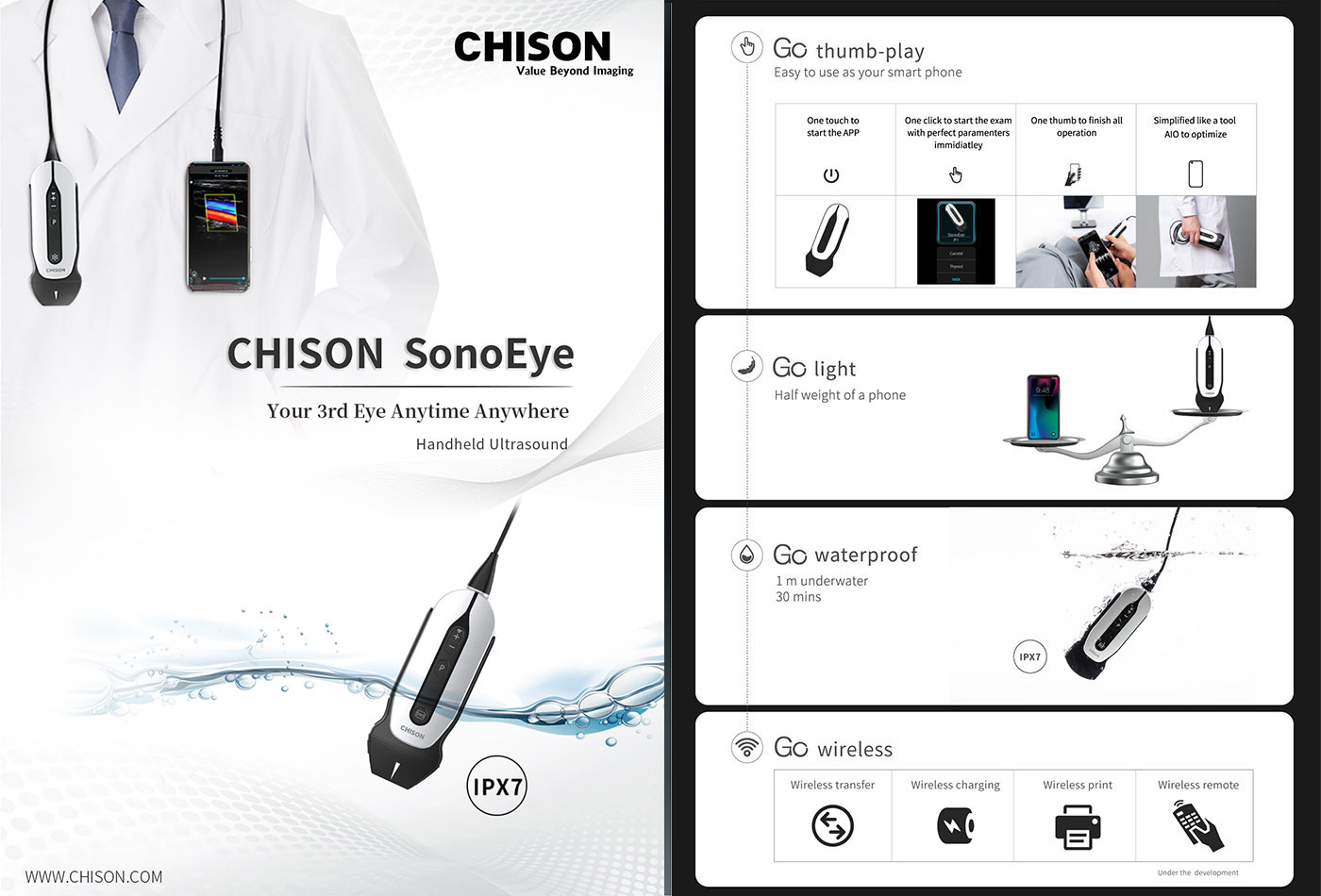
The CHISON SonoEye P3 is a phased-array handheld device whose published applications include cardiac, abdominal and lung imaging. Its page lists B-mode, M-mode, Color and PW Doppler, illustrating why handheld capability should be checked by model rather than dismissed as uniformly basic.
SonoEye connects to a compatible phone or tablet. Evaluate the whole kit: scanner, host device, connection, app access and image transfer. The P3 is one scanner option in the SonoEye family; it should not be presented as a substitute for every transducer used in an emergency department.
CHISON SonoEye handheld ultrasound illustration
For each intended application, ask trained users to assess whether the system provides the necessary views and controls. Include representative imaging conditions and the ability to store useful clips. If a scan is limited, the clinical pathway must allow further assessment rather than treating an inconclusive image as a negative finding.
If automated measurements are part of the proposed package, demonstrate how the operator reviews and corrects them. Ask for evidence supporting any claimed performance benefit for that exact task. An AI feature name does not establish diagnostic accuracy or replace training.
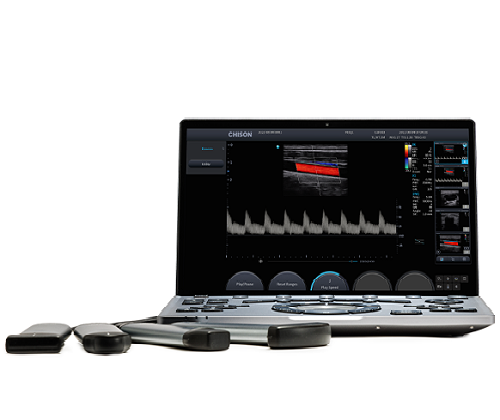
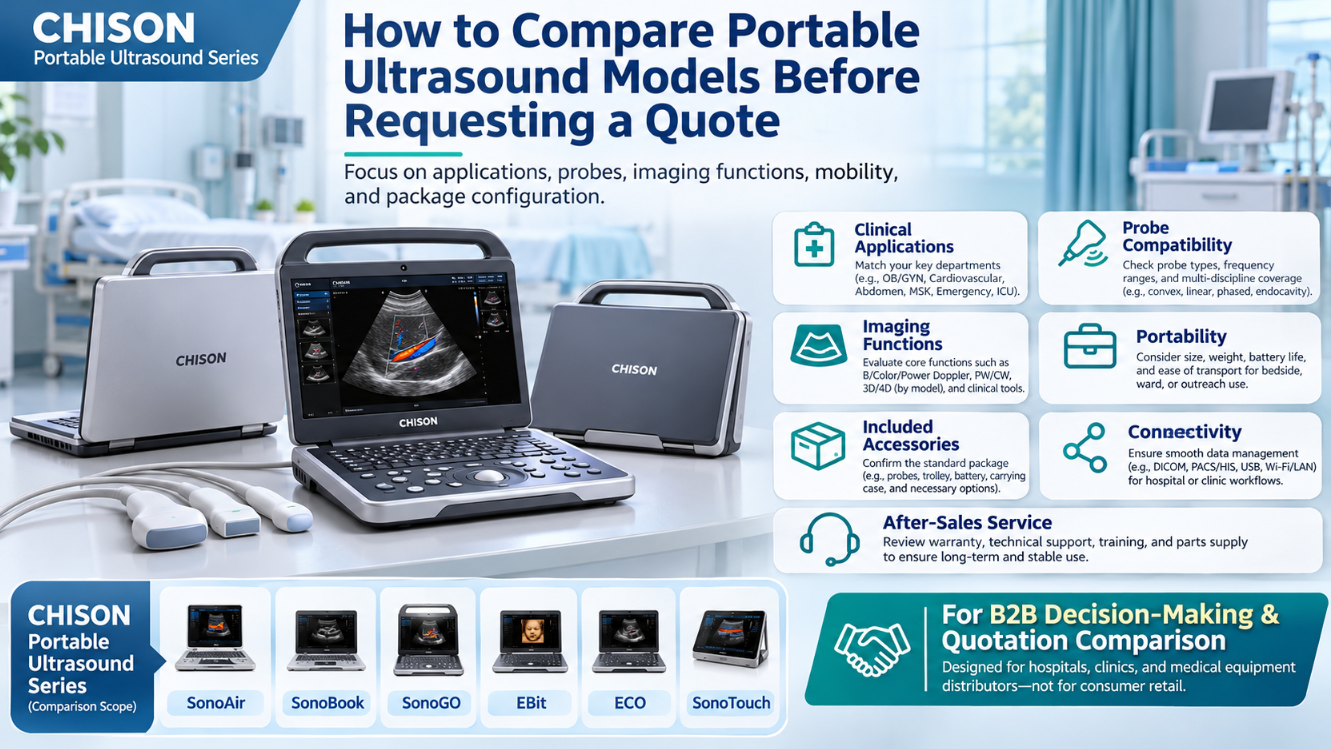
CHISON SonoAir 60 lists emergency medicine and critical care among its applications and specifies a weight of 2.1 kg with battery. It is a candidate for teams that need an integrated system while frequently carrying equipment between clinical locations.
CHISON SonoAir 60 portable ultrasound system
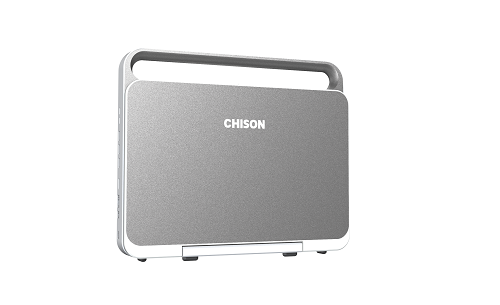
CHISON SonoGO EBit 90 provides a 15.6-inch full-touch display, three probe connectors and a 4.8 kg design. Its multi-probe format is worth evaluating for a shared emergency workspace where users need several compatible transducers available on one system.
CHISON SonoGO EBit 90 shown closed for transport
For both systems, verify the proposed probes, clinical software and export workflow. Published product specifications support shortlisting; they do not establish superiority over another device or guarantee fitness for every emergency application.
The ACEP Clinical Ultrasound Accreditation Program criteria address provider credentialing, program oversight, ongoing education, equipment maintenance, infection control, reporting and image archiving. These are program requirements to plan for with either format; buying a device does not establish an ultrasound service.
A practical demonstration should include registering the patient, saving representative images, documenting the interpretation and retrieving the study for review. Test this workflow with your actual archive and access permissions. A listed connectivity feature does not prove that local integration is complete.
Include the probe, cable, phone or tablet, display and controls in the cleaning workflow. Use manufacturer-compatible methods and follow the required infection-control protocol for the examination. A waterproof rating does not authorize every disinfectant or sterilization method.
The ACEP discussion of common POCUS safety problems highlights practical issues such as approved cleaning materials, probe covers, gel supplies and cable protection. Check how these supplies will be stored and replenished in your own service.
Compare complete working configurations: probes, host devices where needed, software, archive integration, protective accessories, training and service. Ask whether licenses or renewals apply and how equipment will be replaced or repaired. Include the cost of maintaining clinical access during downtime.
Ask each supplier to demonstrate the same sequence with the configuration being quoted: retrieve and prepare the equipment, perform the agreed task, review and save the study, transfer the record, clean the kit and return it to readiness. Record observed delays and missing functions rather than relying on advertised start-up time alone.
This exercise can reveal whether the service needs one format or complementary devices. A handheld assigned to focused bedside work and a portable system in a shared clinical area may be a useful arrangement when staffing, training and review processes support both.
Handheld ultrasound suits focused bedside assessments. Portable systems suit shared workflows requiring multiple probes and a larger display.
Accuracy depends on the device, application and operator—not size alone.
Both can serve different needs, supported by consistent training, cleaning and image review.
SonoEye offers handheld options. SonoAir 60 supports lightweight portable workflows, while SonoGO EBit 90 features a full-touch display and three probe connectors.
Explore CHISON SonoEye, SonoAir and SonoGO. Share your clinical needs and country to request a demonstration and confirm the available configuration.
Contact Us
Copyright © CHISON Medical Technologies Co., Ltd. All Rights Reserved | Privacy and terms of use
Products: Vascular Ultrasound Machine MSK Ultrasound Machine Portable Ultrasound Device Portable Ultrasound Machine for Sale Portable Ultrasound Machines For Pregnancy Handheld Ultrasound For Pregnancy Handheld Veterinary Ultrasound Veterinary Ultrasound Machine Portable Vascular Ultrasound Portable Ultrasound Machine for Cattle and Livestock

CHISON respects your privacy. We use cookies to make our site more personal and enhance your experience. Read our Private Policy to learn more about cookies and how to manage them. You agree to our use of these technologies when you visit our site.
We appreciate your feedback
We sincerely invite you to participate in our survey for helping us to improve our digital market.
*1.How fast does the website load?
*2.Does the products displayed on the website interest you?
*3.How easy is it for you to find the information you need?
4.What information or service do you suggest we can offer?

THANKS
Thank you for sharing your thoughts with us. We’re highly appreciated your every feedback.
Sorry!
THANKS
Thank you for sharing your thoughts with us. We’re highly appreciated your every feedback.
